Not sure whether to go electric or gas for your next water heater? Here's a straight-talk breakdown built for Florida homeowners.
Your water heater quietly handles about 18% of your home’s total energy use. Most people don’t think about it until something goes wrong — and then suddenly it’s the only thing on their mind. If you’re weighing an electric water heater against a gas model, or wondering whether a heat pump or solar system makes more sense in Alachua County, you’re in the right place. This isn’t a generic rundown. It’s a breakdown built for homeowners here, with real data, local context, and honest trade-offs — so you can make a decision you’ll feel good about for the next 10 to 15 years.
“Electric water heater” isn’t one thing — it’s a category that includes several different technologies, each with meaningfully different performance and operating costs. Understanding what you’re actually comparing is the first step to making a smart choice.
The most common type is the standard electric resistance tank. It’s what most homes in Alachua County already have — a cylindrical tank, usually 40 to 50 gallons, that heats water using electric heating elements. These units convert roughly 90 to 95% of the electricity they consume into usable heat, which sounds impressive. The catch is that electricity costs more per unit of energy than natural gas, so even a highly efficient electric resistance unit can run you $500 to $800 per year in operating costs depending on your GRU rate and household size.
Then there’s the heat pump water heater — and this is where the math gets genuinely interesting for Florida homeowners. More on that in a moment.
Every new water heater sold today carries a Uniform Energy Factor rating — UEF for short. It’s the current industry standard for measuring efficiency, and it replaced the older Energy Factor system a few years back. The higher the UEF, the more efficiently the unit converts energy into hot water. You’ll find this number on the yellow Energy Guide label on the unit.
Standard electric resistance water heaters typically carry a UEF between 0.90 and 0.95. That’s solid, but it only tells part of the story. Efficiency at the unit level doesn’t account for what you’re paying per kilowatt-hour. In Gainesville, where Gainesville Regional Utilities supplies power to most of the city and surrounding county, electricity rates directly shape what that UEF number actually costs you month to month.
Heat pump water heaters operate on a completely different principle. Instead of generating heat from scratch, they pull heat from the surrounding air and transfer it into the water — similar to how a refrigerator works, just in reverse. The result is a UEF of 3.0 to 4.0, meaning these units deliver three to four units of heat energy for every one unit of electricity consumed. That’s not a typo. It’s why ENERGY STAR estimates a family of four can save roughly $550 per year and more than $5,600 over the unit’s lifetime compared to a standard electric resistance model.
The trade-off is upfront cost and space. Heat pump water heaters need adequate clearance — typically at least 1,000 cubic feet of surrounding air space — to operate efficiently. They also cost more to purchase. But with a payback period of two to four years through energy savings, and federal tax credits of up to $2,000 currently available for qualifying ENERGY STAR certified models, the economics are hard to argue with for most Alachua County homeowners.
Heat pump water heaters perform best when the air around them is warm. That’s not a problem in Gainesville. The humid subtropical climate here means warm ambient temperatures for most of the year — which is exactly what these units need to run at peak efficiency.
A U.S. Department of Energy Building America study conducted in Windermere, Florida — a climate nearly identical to Gainesville’s — found that a heat pump water heater saved 64% annually on water heating costs compared to a standard electric resistance unit. That translated to real dollar savings, documented in a Florida home, in Florida weather. It’s not a theoretical projection from a cold-climate lab study.
There’s also a misconception worth clearing up: some homeowners assume Florida’s humidity will cause problems for heat pump units. In practice, the warm air temperature benefit far outweighs any humidity-related concern. These systems are designed to handle it, and Florida’s climate actually puts them closer to their ideal operating conditions than most of the country.
One more thing worth knowing for Alachua County specifically: many homes outside Gainesville’s core — in areas like Newberry, High Springs, Hawthorne, Waldo, and rural parts of the county — don’t have access to natural gas distribution lines at all. For those homeowners, the electric vs. gas debate is largely settled by infrastructure. Electric is the practical path forward, and a heat pump model is the smartest version of that choice.
Want live answers?
Connect with a Dee Rooter Plumbing expert for fast, friendly support.
Gas water heaters heat water faster than standard electric resistance models — that’s their most practical advantage. The recovery rate, meaning how quickly the unit reheats a depleted tank, is genuinely higher with gas. For large households that run through hot water quickly, that matters.
Standard natural gas tank water heaters operate at roughly 60 to 70% efficiency — lower than electric resistance units because some heat escapes through the venting system. High-efficiency gas models can reach 80%, but they cost more upfront. Natural gas is also cheaper per unit of energy than electricity in most markets, which is why gas water heaters often have lower annual operating costs despite being less efficient at the unit level.
The key question for Alachua County homeowners is whether natural gas is even available at your address. If it’s not, propane becomes the gas alternative — but propane requires a storage tank, scheduled deliveries, and comes with its own cost and logistics considerations that change the operating cost math considerably.
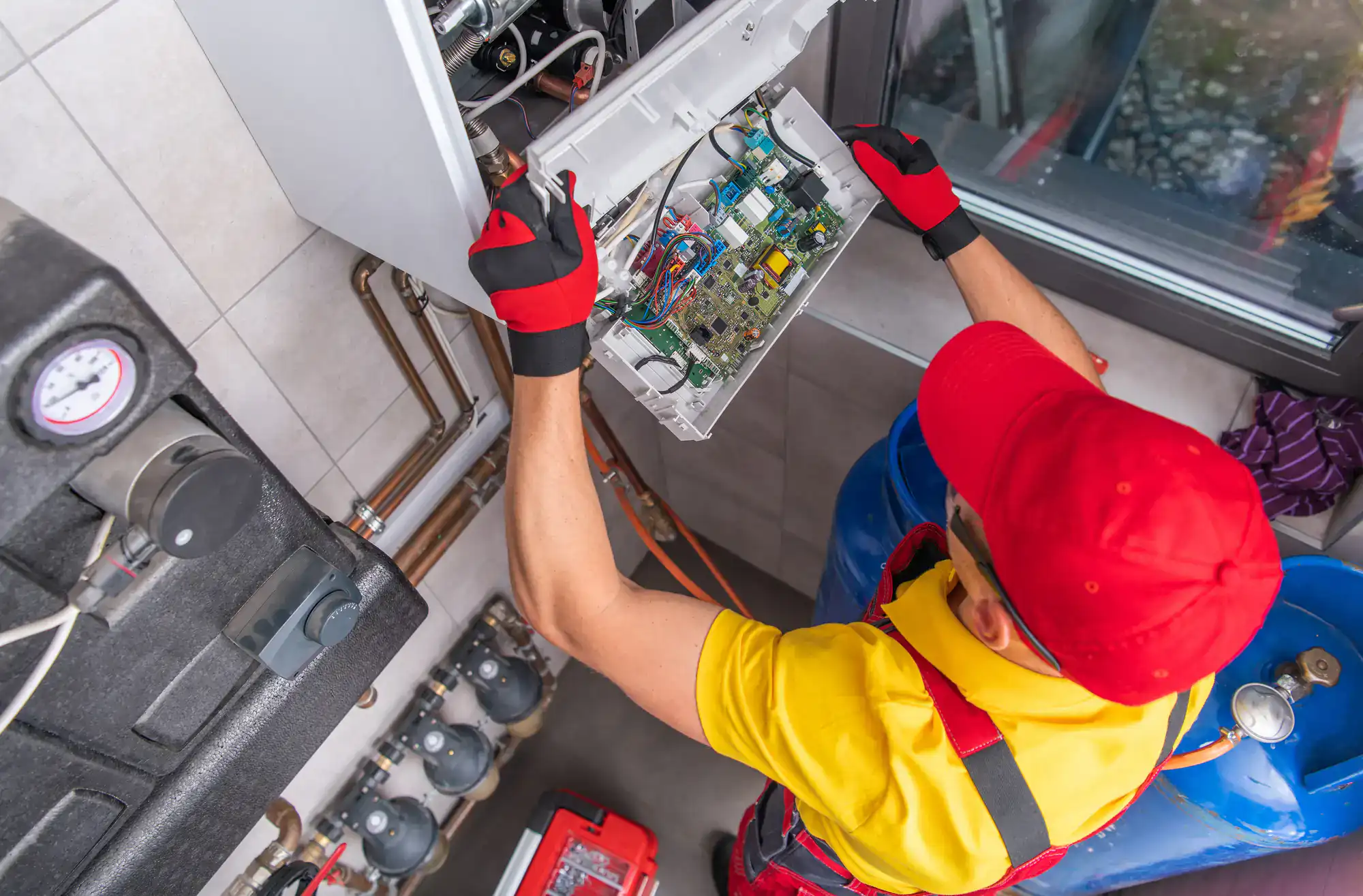
Swapping fuel types is a bigger project than most homeowners expect going in. It’s not just pulling out one unit and sliding in another. Converting from gas to electric — or from electric to gas — can cost anywhere from $870 to $4,100 depending on what your home’s existing infrastructure can support.
On the electric side, a new water heater installation requires a 240-volt dedicated circuit. If your electrical panel doesn’t have the capacity, or if the wiring isn’t in place, that’s additional work before the unit even goes in. On the gas side, you need an existing gas line routed to the water heater location, proper venting (which varies by unit type — atmospheric, direct vent, or power vent), and compliance with the 2023 Florida Building Code, which governs all plumbing and gas appliance installations in Alachua County.
This is exactly why a professional assessment before you commit to a fuel type change is worth the conversation. What looks like a straightforward upgrade can turn into a more involved project if the infrastructure isn’t already in place. Getting a clear picture upfront prevents the kind of surprises that make a $700 water heater feel like a $2,500 job by the time it’s done.
It’s also worth knowing that Alachua County requires a permit for water heater replacement — this comes directly from the Alachua County Department of Growth Management. We pull that permit, schedule the required inspection, and make sure your installation meets code. That step protects your investment and prevents complications if you ever sell the home. It’s not optional, and it’s not something to skip to save a few dollars.
Beyond the standard electric vs. gas comparison, two other technologies deserve a real look — especially for Florida homeowners who want to reduce long-term operating costs.
Heat pump water heaters, as covered earlier, are the standout option for most Alachua County homes that don’t have natural gas access. The efficiency gains are real, the federal tax incentives currently make them more accessible than ever, and Florida’s climate is genuinely well-suited to the technology. ENERGY STAR certified models come with a minimum six-year warranty, and their average lifespan runs 10 to 15 years — longer than most standard tank units. If you have the space and the upfront budget, a heat pump water heater is one of the more financially sound home upgrades available right now.
Solar water heaters occupy a different category. Florida is legitimately one of the best states in the country for solar water heating — abundant sunshine, minimal cloud cover for most of the year, and a climate that keeps the system productive in every season. A solar water heater uses rooftop collectors to absorb heat from the sun and transfer it to your water supply, typically with an electric or gas backup element for cloudy stretches. Upfront costs are higher than conventional systems, but long-term operating costs drop significantly. For homeowners in Gainesville who are already thinking about solar energy more broadly, a solar water heater fits naturally into that picture.
The honest answer on solar is that it’s not the right fit for every home or every budget. Roof orientation, shading, available space, and upfront investment all factor in. But for the right situation, it’s a legitimate long-term play — not just an eco-friendly gesture.
Regardless of which direction you’re leaning, the most important step is matching the technology to your actual home: your household size, your utility setup, your available space, and your budget for both upfront cost and long-term operating expenses. That’s a conversation worth having with someone who knows all the options and can help you find what works best.
There’s no single right answer here — and anyone who tells you otherwise isn’t giving you the full picture. The best water heater for your home depends on whether you have gas service, how much hot water your household uses, what your electrical panel can handle, and how you weigh upfront cost against long-term savings.
What is clear: water heating accounts for nearly a fifth of your home’s energy use, and the decision you make today will affect your utility bills for the next decade or more. That’s worth getting right the first time.
If your current unit is failing or you’re planning ahead, we’re available around the clock — including weekends and holidays — to walk you through your options, assess your home’s setup, and handle the installation from permit to final inspection. No pressure, no surprises on pricing, just a straight answer from a local crew that’s been doing this work in Gainesville for years.
Summary:
Share: